
Let’s be clear: the hardest week for a grieving family is often not the week of the funeral.
It is the week after. The casseroles stop coming. Out-of-town relatives fly home. The flowers start to droop on the kitchen counter. And then the mail starts arriving. Statements. Notices. Forms with their loved one’s name printed on the front, as if nothing happened.
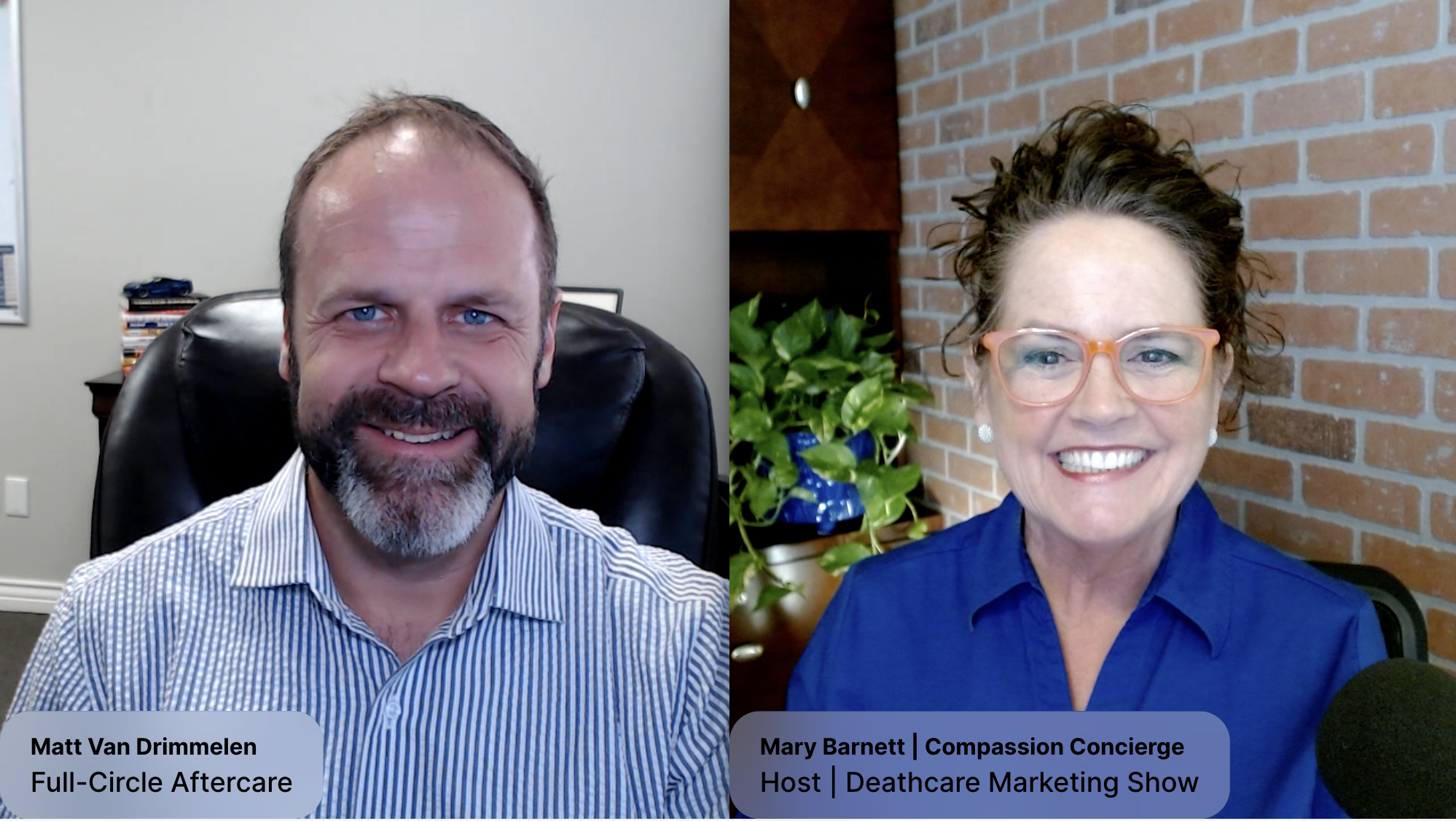
That quiet, lonely stretch is what I got to talk about with Matthew Van Drimmelen, founder of Full Service Aftercare, on episode 16 of The Deathcare Marketing Show. Matthew has built his work around the moment most of us treat as the finish line. And he made a case I think every funeral home owner needs to hear.
The funeral ends. The relationship shouldn’t.
The service is not the finish line
Most of us were trained to see the graveside service as the end of our job. We did everything right. The family was cared for. The day honored a life well lived. Then we step back, because that feels respectful.
Matthew sees it differently. In his view, that moment is when one of your greatest opportunities to build lifelong community trust actually begins. Not because there is something left to sell, but because there is still so much left to carry.
Aftercare is not an extra. It is the foundation of your reputation. It is what a family remembers when a neighbor asks, years from now, “Who did you use when your dad passed?”
The weight families never see coming
Here’s the truth: nobody hands a grieving family the to-do list.
Matthew walked through the administrative burden families face after a loss. Government notifications. Closing bank accounts. Protecting a loved one’s identity from theft. Each one is its own set of phone calls, hold music, and forms, often asking for documents the family has no idea where to find.
Think about what that costs. Not in dollars. In energy. Every unanswered question becomes a small, invisible tax on someone who has nothing left to give. They pay it alone at the kitchen table, late at night, wondering if they are doing it right.
You already know this. You have watched families walk out your door carrying it. The question is whether they carry it alone.
Why the pitch backfires
This is the part of our conversation I want every owner to sit with.
Matthew talked about why transactional pre-need pitches are made immediately after a service fail. And I think we all know why, if we are honest. A family in fresh grief is overwhelmed. They are not curious, not comparing, not planning. They are simply trying to get through Tuesday.
When the first thing they hear from you after the service is an offer, something gets lost in translation. You may mean, “We want to help your family be prepared.” What they hear is, “We were never really here for you.” That gap between what we intend and what a hurting person receives is where trust quietly leaks away.
People in grief are moving through different emotional places, sometimes all in the same afternoon. Overwhelmed. Anxious. Numb. Hopeful for a moment, then not. What they need in each of those places is different, but it is never a brochure. It is someone who shows up with the answer to the question they were afraid to ask.
Serve first. Then serve again. The pre-need conversation will come, in its own time, from a family who already trusts you.
Consistency is the kindness
One idea from the episode stuck with me: consistent, high-touch aftercare systems.
Those two ideas belong together. High-touch means it feels personal. Consistent means it actually happens, for every family, not only the ones your most thoughtful director happened to remember during a busy month.
Most funeral homes I talk with care deeply about aftercare. The care is there. What is missing is a simple rhythm that keeps it from slipping through the cracks when the phones are ringing and the team is stretched thin. Good intentions are beautiful. A plan that shows up on a hard Thursday is what families actually feel.
Simplicity is kindness, especially when families are grieving.
What comes back to you
Here is where it gets even better. Matthew talked about how this kind of care turns grieving families into lifelong advocates for your funeral home. The ones who naturally send referrals. The ones who leave those 5-star Google reviews.
But notice the order. Trust comes first. The reviews and referrals are the fruit, not the root. The moment aftercare becomes a strategy for getting something, families can feel it. When it is simply refusing to disappear, they feel that too.
I keep thinking about Galatians 6:2: “Carry each other’s burdens.” You were called to this work because you know how to carry what other people cannot. Aftercare is just carrying it a little longer, a little farther down the road, after everyone else has gone home.
One question for this week
Ask yourself honestly: if a family you served last month opened their mailbox today and found a stack of forms they did not understand, would they think to call you?
If the answer is no, that is not a failure. It is an invitation.
Matthew and I went much deeper than I could fit here, including what a strong aftercare rhythm can look like inside a busy funeral home. If you lead a funeral home and you want families to remember you for decades, not days, this is the conversation for you. Listen to episode 16 of The Deathcare Marketing Show wherever you get your podcasts, and subscribe so the next one finds you.
Because the families you serve deserve someone who stays. 💛
Watch the full episode here: https://youtu.be/_xMdgrZZFc4